Wednesday, August 3, 2011

10 Steps to Be Prepared for 2011 Taxes


Plan Now for Next Year's Tax Season

reprinted from SmallBusinessComputing.com

"Once you've completed 2010 taxes, set aside time -- while this year's paperwork challenges are still fresh -- to establish better habits for 2011," said Alice Bredin, small business advisor to American Express Open, a credit card company and the home of AcceptPay, an online electronic billing and payment acceptance program for small businesses. "A little work now on better tracking income and expenses will make next year's tax season go much more smoothly."

Certainly starting early makes it easier to file your taxes, but there is another striking advantage as well. With all the tax changes for 2011, you can get many of the things you previously thought you couldn't afford -- such as more employees, new equipment and more-affordable health insurance.

However, those tax benefits come with strings, primarily in reporting and percentage-based requirements. Therefore, you need to start tracking your actions now. The easiest way to do all this is to use accounting software and to plan ahead using these helpful tips.

10 Easy Steps to Prepare for 2011 Taxes

1. Sync Small Business Accounting Software with Your Accountant

Sync your small business accounting software with your accountant's, which simply means either use the same software he or she does or a compatible program. By doing so, everything from payroll taxes to quarterly P&L statements and end-of-year tax filing becomes automatic.

Several software programs allow your accountant access (with your authorization, of course), so the accountant can access your books and do his work without you having to do anything. Other software programs let you send the data to your accountant with just a few clicks. In any case, you want to use accounting software that provides an IRS-approved electronic audit trail, such as Peachtree Accounting or QuickBooks, so that even a tax audit becomes a no-brainer, less-stressful affair.

2. Use Online Banking

Online banking can help you keep records straight for tax time and help you stay on track from month to month. Most accounting software lets you automatically import data from your online checking account, but there are other ways to use online banking info, too.

"Most banks will let you download your transactions into an Excel spreadsheet or some type of electronic, sortable format," said Karla Dennis, a Licensed Enrolled Agent and CEO of Cohesive, a California-based tax preparation and consultancy firm. "If you download your transactions using your iPad, desktop or laptop, you can then put a 'T' next to the items that are tax related. If you do this every month, you will have a nice record of tax deductible items when it's time to file your 2011 tax return," she said.

3. Record Everything Electronically

"Scan bank statements (if you're not using online banking), vendor statements, receipts, credit card statements, everything. Scan it all as soon as you receive it," said Andrea Moe, senior director of product management and marketing at Sage, the makers of Peachtree Accounting. By creating an archive of all your records, you'll always have everything you need, anytime you need it.

4. Backup Electronic Records

To prevent financial ruin as a result of man-made or natural disasters, or even from a spiteful employee or an errant finger stroke, make sure you backup everything routinely and regularly. "Don't just back it up on a flash drive or CD, back it up to a remote location," said Moe. "That way, if your building burns or floods, your backup isn't destroyed along with your primary records."

There are a number of programs that can automatically back-up everything on your computer --including some that come pre-installed on new computers such as Dell DataSafe Online -- and others that you can downloaded, such as Mozy and Carbonite. Check to see if your accounting software supplier also has an automatic backup service -- several do. The added advantage to backing up online is that you can access your financial info any time -- even when you're away from the office.

5. Track Health Insurance Policies

The Small Business Jobs Act entitles a sole proprietor to reduce self-employment tax by the amount of deductible health insurance premiums. "For small businesses that pay at least half of their employees' policies, there are substantial tax credits available. Check with your accountant for details, but do track policy costs throughout the year. That way you'll have an exact record if you change insurance companies or coverage.

6. File Online -- It's the Law

"Small businesses are now required to file 941 forms (quarterly payroll taxes) and unemployment forms electronically," said Moe. "If you're not using automated accounting software or a third-party payroll company, you may find it really difficult to file these electronically." Be warned, the fines for failing to file online and on time can be significant.

7. Use Electronic Calendars

Odds are you already use an electronic calendar on your computer or smartphone. You can also use it to jog your memory as to which trips and meals qualify as tax deductible -- thus giving you a good way to double-check your deductions at tax time.

"Make a note of any appointment that is tax related by indicating so with a 'T' right in the subject line," said Dennis. "At the end of the year, you can print out your appointments, and anything with a 'T' next to it is something you need to follow up on for your taxes."

8. Profit by Hiring

In the current economy, many businesses are reluctant to hire employees. However, the government is offering employers a $1,000 tax credit for each employee hired. "The business owner must retain the new employee for at least a year," said Mike D'Avolio, senior tax analyst at Intuit, the makers of QuickBooks.

"Also, the employee's wages during the last 26 week period must equal at least 80 percent of the first 26 week period." In order to benefit from this tax credit, it's important to track length of employment and to calculate earnings against this rule – a task some accounting software will do for you automatically. In comparison, the shoe box won't track this at all, and you can end up working short-handed and paying more taxes.

9. Buy More Assets with Tax Credits

The government is encouraging small businesses to purchase assets by expanding several incentives. Businesses can claim a 100 percent bonus depreciation deduction for new assets purchased in 2011. "Personal property, such as machinery and equipment, qualifies; but real estate does not," said D'Avolio.

Even though the purchase of used property does not qualify for this 100 percent bonus depreciation provision, D'Avolio said it does qualify for a section 179 expense deduction. There is a $500,000 limit for 2011. Certain types of real estate qualify for the section 179 expense deduction with a $250,000 limit.

10. Avoid Huge Penalties for Late Reporting

According to Greatland, the parent company to tax-filing software such as FileTaxes.com and speedEfiler, the Small Business Jobs and Credit Act of 2010 will increase 1099 and W-2 reporting penalties across the board. This will apply to information returns filed on or after Jan. 1, 2011, and therefore, all payments made in 2010.

The maximum failure-to-file penalty increases to $500,000 (up from $100,000) The maximum penalty for issuing corrections within 30 days increases to $75,000 (up from $25,000) while the penalty for issuing corrections more than 30 days past the due date, but before Aug, 1, increases to $200,000 (up from $50,000).

Additionally, a new provision in the healthcare reform legislation is aimed at improving reporting and closing the tax gap. "It will require all businesses to not only issue a 1099 to document income paid to contract workers, but also issue a 1099 form to any business from which they purchase at least $600 in goods or services," said Bob Nault, Greatland's CEO. "Some estimate that this change will have the average business seeing its 1099 reporting increase tenfold -- a burden expected to only be compounded next year if businesses don't begin to prepare in 2011."

Accounting software can automatically issue these 1099s for you. If you fail to start issuing 1099s and W2s according to these new laws, the penalties could rob you of your business. In the end, you could be left with nothing but your shoe box of receipts.

Thursday, July 28, 2011

The Easiest Way to Get Rich


reprinted from Paul's Tips

Judging by their behavior, most people have an obsession with wealth. Politicians promise to create it, most popular magazines are filled with gossip about those who have it, and the average person spends much of their adult life trying to obtain it. We are creatures obsessed with money, partly for what it can buy, but also as a thing of value in itself.


But most people misunderstand money. They don't really know how to obtain it, or how to hold onto it once they have it. If you're interested in getting rich, I'm going to give you the simplest formula for doing so. In fact, if you follow it you're virtually guaranteed to build enough wealth to get you into the top 5% of society. As the shampoo advertisement says: "It won't happen overnight, but it will happen".

The hardest way to get rich
Before I go into my formula, let me tell you about hard ways to get rich.

One of the hardest is to be born into it. Of course, if you happen to enter this world as a Hilton, a Gates or a Windsor, then life is sweet. But since 99.9999% of the population aren't that lucky, I'm assuming you didn't win that particular lottery. And speaking of lotteries, gambling is another very difficult way to get rich. Sure, some people buy a lottery ticket and win big, but most don't. You can gamble your entire life and you'll most likely end up broke rather than wealthy. When I was younger, I thought the easiest way to get rich was to become famous through some kind of creative act. Stephen King got rich writing horror novels, so why not me? I'm now much wiser and realize that the vast majority of novelists never even get published. Of those who do, most wallow in obscurity. Only very few make it anywhere near the best-seller list, and only one in a million will achieve any kind of serious wealth.

The same fate awaits the majority of musicians, software company founders, sportspeople and website creator. For every Google that makes its owners billions, there are a million websites that lose money. Creativity is the most fun and rewarding way to get rich, but it's also a very difficult way. The reason the media raves about and idolizes those who've built wealth through creativity is because they're so rare. You don't hear about the vast majority who wallow in obscurity and poor pay, because they're not interesting. "Young genius makes $1 billion from website" is a great headline "Ten thousand young geniuses make nothing from their hard work" isn't. I'm not saying you shouldn't keep your dreams alive. It's one of the best parts of life. But this article isn't about the most fun way to try and get rich - it's about the easiest way.

Okay, here's the system.

Step 1: Get a well-paid job
This is a reasonable amount of work, and takes a few years, but it's a virtually guaranteed way to make a good income. If they're willing to put in the work, almost any intelligent person can get a job paying $100,000 or more within the space of a few years. While it's not easy, it is by far the easiest and most likely way to secure a good income. In fact, I've already written an entire article on how to get a job paying more than $100,000 a year for those who wish to pursue this avenue.

Step 2: Get good tax advice
However you make your money, your number one expense is likely to be funding the government. In most developed countries, the average worker pays around 30% of everything they earn straight into the taxman's pocket. If you've taken my job advice, you'll most likely pay even more than that.

While taxation is necessary to fund the good things governments provide, you don't do yourself any favors by paying more than your fair share. If you're serious about building wealth, get a good accountant who understands how to legally minimize your tax bill.

Step 3: Save 20% of everything you ever earn
As soon as you get paid, arrange to have 20% of your income removed into a savings account. Many banks can do this automatically for you. Keep your savings account separate from your spending account, and you'll barely miss this money.

There's a saying in economics "expenses rise to meet income". This means money that's easily available to you is certain to be spent. That's why most people's paychecks disappear before their next payday. They get used to having a certain amount to spend, and habitually run down their bank account.

Have your savings moved somewhere it's a hassle to get them out of to avoid this risk. Many high interest accounts require you to give them a few days notice, which is ideal for this purpose.

Step 4: Conservatively invest the funds that build up in your savings account
Once a month, go into your savings account and divide the money by investing it into the three core conservative assets: shares, property and cash. Open a mutual fund account for shares, a property fund for property, and a money market fund for cash. Look for share and property funds that invest in a broad range of assets and most importantly charge very low fees. An index fund is ideal for the shares. An index of property funds is ideal for property.

Put an equal amount into each account. This will diversify you against risk in any one particular asset. If you're younger, this rule is a little bit flexible, allowing you to take a little more risk and put more into shares and property if you like.

Step 5: Reinvest any income you get from your assets straight back into buying more assets
Mutual funds and property funds pay dividends. Money market accounts pay interest. Don't take this income into your spending account. Instead, select the option to have it reinvested into the fund that generated it.

Step 6: Never touch these funds and do your best to ignore them
The business press, like the mainstream press, loves a crisis. "Shares to skyrocket" or "Property to plummet" headlines will sell many more copies than "Things to continue steadily". All markets go up and down. Every day, some speculation will be published about some crisis or opportunity.

Ignore it all.

Just keep putting the 20% into your assets. Sometimes they'll go up and sometimes they'll go down in value. But over the long term, they'll almost certainly go up.

Step 7: Wait a decade
Do what I've outlined above and in a decade you'll be rich. Sure, you won't be Bill Gates, but you'll almost certainly be in the top 20% of wealth holders. Wait another decade and you'll be in the top 5% or higher.

That's the plan. It's not the most exciting or glamorous way to build wealth, but it's the easiest. Quite simply, this is how most rich people got there.

You too can join them, if you follow it.

Wednesday, July 27, 2011

5 Wealth Lessons from 20 Percent of a Millionaire


reprinted from www.stevepavlina.com


While I’ve long dreamed of becoming a millionaire (who hasn’t?), it was only last year that I began taking it seriously. What motivated me wasn’t the thought of buying lots of stuff or quitting my job (what job?!?) and retiring. Instead I got inspired by the idea that if I could figure out how to earn a million dollars, I could share what I learned and hopefully help a great number of people.

After a solid year of working at it, it’s a bit unclear whether or not I’m a millionaire yet. If I add up my cash, cash equivalents, and tangible assets, my net worth is roughly $200K, so I’m at least 20% of the way there. However, Erin and I own several online assets that are likely worth much more than that. It’s entirely possible that StevePavlina.com could receive a paper valuation of over $1 million due to its income (about $40K/month), its continued growth potential, and its extremely low operating costs. One blog valuation tool estimates this site as being worth over $1.6 million. I have no intention of selling this business though, so I don’t see that figure as particularly meaningful. Consequently, I’ll stick with the 20% of a millionaire tag for now.

I suggest we leave the labeling issues to those who enjoy obsessing over such matters, and I’ll proceed to share the wealth-building lessons I’ve found most valuable. Then you can make up your own mind about how helpful they are to you:

1. It’s damned hard to earn a million dollars from scratch.

This is just common sense, but I have to say it to counter the scammers who preach that you can earn a million dollars via their fast, easy, foolproof methods for only 3 easy payments of $19.95.

Perhaps you can earn a million dollars by using emotional manipulation to sell people useless, overpriced information products, but assuming you’re not a scam artist, you’re going to have to earn the money by providing a million dollars worth of real value. For most people, including me, that’s a huge challenge.

Respecting the magnitude of this challenge actually helps though. If you take this goal seriously, you’ll realize you must make a massive commitment to have a real chance of getting there.

People who say they want to become a millionaire but are unwilling to back it up with hard work are only fooling themselves. It’s not going to happen by itself. If hard work is a dirty word to you, don’t bother.

However, the great thing about this goal is that it’s achievable. People in far worse positions than you have already done it. It’s hard but definitely not impossible. If you accept this, it becomes something of a game. You don’t have to fear failure because you’re expected to fail, and that makes success all the more exciting.

2. Self-interest is insufficient motivation.

Given the magnitude of this challenge, tremendous motivation is required to lay in the course and persevere through the inevitable obstacles.

I found that wanting to become a millionaire for the benefit of myself or my family just didn’t cut it. I just don’t need more money or stuff badly enough to justify the effort. On a scale of 1-10, my level of materialism is about a 3. Even my friends could agree on that during a recent game of Therapy. Give me a fast PC and a high-speed Internet connection, and I’m good to go. I’m sure some people can get excited about earning a million dollars for all the cool stuff they can buy… or maybe for the status and recognition, but those aspects don’t do it for me. I’d rather play disc golf.

Unfortunately, this goal requires a lot more than mediocre motivation. You need to be seriously driven. Anyone who tells you otherwise is probably about to pitch you on 3 easy payments of $19.95. But where is that drive going to come from?

After some serious soul searching, I gave up on the idea of becoming a millionaire for myself. I just didn’t want it badly enough. If I did I’d have done it years ago with my computer games business, which I believe was entirely capable of getting there. I felt like a dolt for dropping this goal, but I also felt a sense of relief about the whole thing. It freed me up to focus on more important priorities like service and contribution.

Ironically it was the decision to put contribution ahead of wealth that led me full circle. Eventually I realized that becoming a millionaire could dramatically enhance my ability to help others.

By sharing what I’m learning along the way (as I’m doing right now), I can potentially inspire others to generate income by providing value instead of thinking they need to scam or trick people to get ahead. If even a small fraction of this website’s 1.5 million monthly visitors increase the value they provide to others as a result of the info I share, something truly wonderful will have occurred.

I also started thinking about what I could do with a million dollars. One idea I find very inspiring is to found a non-profit personal development organization, which would ultimately have thousands of individual groups all around the world. In structure I imagine it being similar to Toastmasters International, which has 200,000 members and 10,000 clubs worldwide. You could find a local group near you filled with people dedicated to helping and supporting each other grow, very similar to a mastermind group. In fact, the Local Groups forum on this site is a very basic first step towards the realization of that long-term vision. Forum members are already having local meet-ups in cities around the world. I’m so excited to see this happening. Best of all it’s 100% free for everyone.

Considering the contribution aspects helped shift the millionaire goal from my head to my heart. I finally got enough leverage on myself to seriously commit to it. I realized this goal was potentially something much bigger than just me and my family, and taken in that light, I felt like I’d have to be a real schlub not to give it my all.

Even though it seems like earning a million dollars is a totally selfish goal, I’ve found that it’s just the opposite. Contribution is a far more powerful motivator than enlightened self-interest.

3. Focus on providing value to others, and the money will follow.

I figured that earning a million dollars should be pretty easy if I could determine how to provide at least a million dollars worth of value to others. Unfortunately I don’t know how to provide a million dollars in value to a single person (and get paid for it), so I figured I’d have to make it up in volume… maybe by providing $1 of value to a million people. I know I can create something that’s worth at least $1 to someone – one good article should do it — so the key is figuring out how to get that value into the hands of as many people as possible.

I think the best way to provide $1 of value (or thereabouts) to as many people as possible is to give it away for free. Who isn’t going to accept a free dollar? While you’d go bankrupt doing this with a tangible product, this can be done sanely with digital content. And thanks to the Internet, it’s possible to reach a large audience at extremely low cost. As for the details of how to create valuable online content, check out How to Build a High Traffic Web Site.

Once you can generate value and get it into people’s hands, the income part is relatively easy by comparison. It’s not automatic, mind you. You still have to set up systems to do it right, but that can be achieved via trial and error if necessary.

Consider this analogy: Suppose you own an empty warehouse, and you have thousands of people passing through it each day. Could you generate some income from those visits? Of course you could. You could sell lemonade, sell sponsored billboard ads on the walls, sell car insurance, solicit donations, etc. Some methods will bomb, but some will prove very effective. Given enough trial and error, testing, and refinement, you’ll eventually establish a reasonable income stream. Generating that foot traffic is the hard part, but in the online world it’s a lot easier because you can offer something valuable for free that doesn’t cost you anything to give away. OK, it does cost you a little because you have to pay for web hosting and bandwidth, but for me that expense is about 1/100 of a cent per monthly visitor. Going back to the empty warehouse analogy, you could do just about anything and earn more than a penny for every 100 visitors.

This site only earns about 3 cents per visitor per month on average, so I can say without conceit that it’s giving a lot more than it receives. I have to believe the 500+ articles here are worth more than 3 cents to virtually anyone who can read. Have you gotten your 3 cents worth from this site yet? What do you estimate it’s actually worth to you?

The upside is that this value imbalance generates massive referrals. It’s the main reason this site has blown past the web traffic levels of every famous pro speaker or author in the field of personal development, even though I’ve never spent a dime on marketing. While others firewall their value behind those 3 easy payments, this site’s content is free. It’s hard to compete with free.

To generate a million dollars in this situation, I can either find a way to provide even more value, or I can get better at monetizing the existing value. My plan is to actually do a little of both by making some changes to the business model this year. Rest assured the articles will remain free. Check back at the end of 2007, and we’ll see how well it worked.

I’m sharing this info with you, so you can understand the underlying strategy of generating income by providing genuine value. Forget about trying to get a million dollars, and focus your energies on providing a million dollars worth of value. If you can do that, the money will come.

For more on generating income by providing value, read Making Money Consciously.

4. Becoming a millionaire requires a significant identity shift.

To become a millionaire, you must become comfortable thinking and acting like a millionaire. If you can’t get there in your mind first, you won’t get there in your reality.

I realized that if I became a millionaire, I’d have to be comfortable managing larger sums of money. At the time I started on this path, $10,000 was a lot of money to me. But to a millionaire, it’s a relatively puny sum, only 1% or less of their net worth. So I began imagining that $10,000 was just a small amount of money and thinking about what that would feel like. Eventually I began to really believe it.

Secondly, I realized that if I were a millionaire, I’d carry more cash in my wallet. At the time I was comfortable having $50-70 in my wallet. $100 felt like a lot. So I went to the ATM and took out $200 and put it in my wallet. It felt uncomfortable to carry that much cash, but I got used to it after a few weeks. Over time I gradually raised my baseline until it felt normal having $300-500 in my wallet. Now when I have only $200 in my wallet, I sense a desire to go to the ATM.

Thirdly, I realized that to a millionaire, any sum below $100 or so is essentially irrelevant. If you’re already a millionaire, a few dollars here and there just don’t matter. Worrying about those kinds of sums is like fussing over pennies. I started telling myself that there’s no financial difference whatsoever between a $20 dinner and a $50 dinner. Going to a $9 movie is nearly identical to seeing a $90 show on the Las Vegas Strip. Those amounts are just pennies anyway.

As I gradually integrated these internal shifts, my income began to soar. Over a period of 12 months, StevePavlina.com’s monthly revenue went from $2K to $40K. As I made small changes to pretend like I was already a millionaire (in a safe and low-risk manner), I began attracting opportunities to earn more money.

Let’s be clear that I didn’t suddenly adopt foolhardy spending habits, even on low amounts, because a millionaire wouldn’t spend money foolishly. I kept my expenses reasonable, but I learned to stop fussing over amounts that really didn’t matter, like whether or not I should order a drink (non-alcoholic of course) with dinner. I’m never going to miss the $2 whether I become a millionaire or not.

Today any expense below $100 is effectively meaningless to me. $100 isn’t even 10% of a day’s earnings. This makes many purchasing decisions easier, since if the price difference between two items is less than $100 (such as the difference between two iPod models), I don’t even worry about it — I just buy the better model. The price difference is only pennies anyway.

It’s fascinating to me that I adopted this mindset first, and then the income manifested to fit the mindset. I suppose the next step is to start thinking of even larger sums as essentially irrelevant. It might seem counterintuitive that this method works, but it just does. If you want to be wealthier, start thinking like you’re already there.

5. Financial trolls must be shown no mercy.

In the terminology of online forums, a troll is someone who “intentionally tries to cause disruption, often in the form of posting messages that are inflammatory, insulting, or off-topic, with the intent of provoking a reaction from others.” (source: Wikipedia)

After launching the forums on this site over two months ago, the moderators and I gradually developed our troll-squashing shoes. At first we opted to be fairly lenient, giving polite warnings and reminding trolls to follow the posted etiquette guidelines. That never worked. All it did was embolden the trolls to keep on trolling. Every troll ended up getting himself banned eventually, but only after wasting a lot of people’s time. Eventually we learned the best approach was to banish trolls immediately on sight. It seems obvious in retrospect, since the kind of person who’d resort to trolling in the first place isn’t someone who’d genuinely care about personal development, but it was an important lesson nonetheless.

A financial troll is a close cousin to the forum troll, except that financial trolls strive to sabotage your financial pursuits. These trolls can be internal or external. They’re the people who make comments like, “Wealthy people are so greedy. They only care about themselves and will take advantage of anyone to make money.” Financial trolls are also the internal voices that say, “If you make too much money, people will judge you harshly for it. They’ll assume that’s all you care about.”

It’s tempting to listen to financial trolls because their statements are crafted to bait you into pointless arguments. Whenever you take the bait, you lose no matter what because trolls don’t care about arguing logically. If you agree with a troll, you lose. If you disagree with a troll, you lose. You’ll never convince a troll of anything no matter how hard you try. A troll’s agenda is to boost his own ego by making you wrong and by wasting your time. The more time you invest in dealing with the troll, the more you lose.

The only effective way to deal with trolls is to delete them from your life, no questions asked. Just nuke the sucker and move on. With face-to-face trolls, simply leave the room. If you really need a parting shot, consider the way Debra on Everybody Loves Raymond glares at Ray and then delivers the line, “Idiot!” If that isn’t your style, a simple eye roll works pretty well too.

Every once in a while someone sends me an email like, “Oh come now. It’s obvious you’re just in this for the money. Don’t even pretend you care about helping others. That’s just a load of self-serving B.S. You’re such a phony.” My external response is to simply hit the delete key. But my internal response is to recall a line from the movie Ruthless People: “This could very well be the stupidest person on the face of the earth.”

There’s a huge difference between constructive criticism and trolling. The former can be genuinely helpful. The latter never is. By all means listen to constructive criticism, but when you know the other person doesn’t actually have your best interest at heart, hang up on them and get back to work.

Show no mercy to financial trolls, whether they be internal or external. Once you recognize you’ve got a troll on your hands, hit the delete key and be done with it. Invest your time in making a contribution instead of becoming mired in a troll’s trap. When it comes to dealing with trolls, even when you think you’ve won, you’ve lost.

There are more lessons than these, which I’ll probably share in a future article, but the five above should get you off to a good start in generating greater financial abundance. For the most part these items are common sense, but in practice they’re fairly uncommon.

How often do you ignore your common sense and succumb to traps like wishful thinking, with its promise of fast and easy results; trolling, with its lure of intelligent debate; and penny pinching, with its prideful certainty that saving five dollars is better than earning five hundred? If the financial advice you’ve been getting hasn’t proven itself effective, then toss it out and rebuild your financial beliefs from ground zero. If you want to become a millionaire in 10 years or less, you can’t subscribe to the 40-year skimp-and-save approach. Sure you can save your way to a million in 40 years, but you can earn your way there a lot faster.

Friday, June 24, 2011

gas-nozzle-money.jpg

IRS Increases Mileage Rate to 55.5 Cents per Mile

WASHINGTON — The Internal Revenue Service today announced an increase in the optional standard mileage rates for the final six months of 2011. Taxpayers may use the optional standard rates to calculate the deductible costs of operating an automobile for business and other purposes.

The rate will increase to 55.5 cents a mile for all business miles driven from July 1, 2011, through Dec. 31, 2011. This is an increase of 4.5 cents from the 51 cent rate in effect for the first six months of 2011, as set forth in Revenue Procedure 2010-51.

In recognition of recent gasoline price increases, the IRS made this special adjustment for the final months of 2011. The IRS normally updates the mileage rates once a year in the fall for the next calendar year.

"This year's increased gas prices are having a major impact on individual Americans. The IRS is adjusting the standard mileage rates to better reflect the recent increase in gas prices," said IRS Commissioner Doug Shulman. "We are taking this step so the reimbursement rate will be fair to taxpayers."

While gasoline is a significant factor in the mileage figure, other items enter into the calculation of mileage rates, such as depreciation and insurance and other fixed and variable costs.

The optional business standard mileage rate is used to compute the deductible costs of operating an automobile for business use in lieu of tracking actual costs. This rate is also used as a benchmark by the federal government and many businesses to reimburse their employees for mileage.

The new six-month rate for computing deductible medical or moving expenses will also increase by 4.5 cents to 23.5 cents a mile, up from 19 cents for the first six months of 2011. The rate for providing services for charitable organizations is set by statute, not the IRS, and remains at 14 cents a mile.

The new rates are contained in Announcement 2011-40 on the optional standard mileage rates.

Taxpayers always have the option of calculating the actual costs of using their vehicle rather than using the standard mileage rates.

Mileage Rate Changes

Purpose

Rates 1/1 through 6/30/11

Rates 7/1 through 12/31/11

Business

51

55.5

Medical/Moving

19

23.5

Charitable

14

14


Friday, May 27, 2011

Just What You Needed: Higher Taxes


Here is a great article I read about Employment and Self Employment Taxes. It is from SmartMoney taken from Yahoo Finance, written by Bill Bischoff. You have been hearing a lot about raising taxes and tax breaks. That all has to do with Income Tax. These are the other (not so) little taxes that everyone pays. As it stands right now, the money will run out, so one of two things needs to happen. We need to pay in more, or there needs to be less paid out. Over the next 20 years, I bet you can expect both of these things to happen, as well as the age ceiling raised for when you get your payouts.

-David Bixel

SmartMoney

While you hear a lot about the federal income tax, you don't hear much about the Social Security tax. That's odd because for many folks especially the self-employed Social Security tax can be the bigger hit. Here are some little-known truths about how the Social Security tax works and how much it can amount to.

As an employee, your wages are hit with the 12.4% Social Security tax up to the annual wage ceiling. Half the Social Security tax bill (equal to 6.2%) is withheld from your paychecks. The other half is paid by your employer. Unless you understand how the tax works and closely examine your pay stubs, you may be blissfully unaware of how much the Social Security tax actually costs.

The Social Security tax wage ceiling for both 2010 and 2011 is $106,800. If you made that much or more last year, the Social Security tax hit on your 2010 wages was a whopping $13,243 (12.4% x $106,800). Half came out of your paycheck. Your employer paid the other half.

For 2011, the tax hit is less, thanks to a one-year 2 percentage-point reduction in the Social Security tax withholding rate on wages -- from the normal 6.2% to 4.2% (your employer's 6.2% rate is unchanged). For 2012 and beyond, however, Social Security tax withholding on your wages will jump back to the standard 6.2% rate.

While many employees may not realize the magnitude of the Social Security tax, self-employed folks know it all too well. That's because the self-employed must pay the entire 12.4% tax rate out of their own pockets, based on the amount of their net self-employment income. This is one big reason why companies often prefer to treat workers as self-employed independent contractors rather than employees. Companies don't owe any Social Security tax on amounts paid to independent contractors.

For both 2010 and 2011, the Social Security tax self-employment income ceiling is $106,800 (same as the wage ceiling for employees). So if your 2010 self-employment income was $106,800 or more, you paid the Social Security tax maximum of $13,243 last year (12.4% x $106,800 = $13,243).

In 2011, the hit will be less thanks to a one-year 2 percentage-point reduction in the Social Security tax rate on self-employment income -- from the normal 12.4% to 10.4%. For 2012 and beyond, however, the Social Security tax on self-employment income is scheduled to return to the standard 12.4% rate.

To give you an idea of how the Social Security tax can add up over your working life, consider my personal situation. In 35 years behind the grindstone (about half as an employee and the other half self-employed), I've paid $219,000 in Social Security tax. My employers paid another $41,000. That amounts to $260,000 in total. During my time as a self-employed guy, I've had some years where my Social Tax bill exceeded my combined federal and state income tax bills.

Believe me, if I could get the $260,000 back, stop paying the tax, and forego receiving any benefits, I would do it in a heartbeat. In fact, if I could just stop paying the tax in exchange for walking away from any future benefits, I would do that too. Why? Because I have big doubts I will actually receive the promised level of benefits when the time comes.

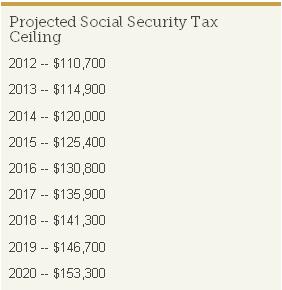
And thanks to the government's official contention that there has been little to no inflation over the past few years, the Social Security tax ceiling has been stuck at $106,800 since 2009. However, the latest Social Security Administration projection says it will start rising again in 2012 and beyond. The projected ceilings for the next nine years are as follows.

If these numbers pan out, the maximum Social Security tax hit in 2020 would be $19,009 (12.4% x $153,300). That's assuming Congress doesn't increase the tax rate, which could easily happen. There's also a chance the ceiling will be increased beyond what you see here or even entirely removed in an attempt to put the system on a sounder financial footing. If there's no ceiling, you would owe Social Security tax on wages and self-employment income on every dollar you earn.

Another misunderstanding about Social Security: Some people think the government has set up an account with their name on it to hold the money to pay for their future Social Security benefits. After all, that must be where all the Social Security taxes on people's wages and self-employment income go, right? Wrong. There are no individual accounts. In fact, when the Social Security system runs a surplus (which it has in most years until now), the federal government sucks out the excess cash and issues the system an IOU. But the only way those IOUs will ever be paid is through future taxes. Meanwhile, the system is now projected to run out of money (including those nebulous IOUs) in 2036 unless taxes are raised or benefits are cut.

Copyrighted, SmartMoney.com. All Rights Reserved.

Saturday, April 9, 2011

IRS

Once you have filed your taxes with us you can find out the status of your refund at . Make sure you wait 72 hours to check after the IRS acknowledges receipt of your e-filed return. If you went the snail mail route, you'll have to wait up to four weeks.

For finding out the answer to Where's my refund, you'll need a few key pieces of information:

-Your SS# (or IRS individual taxpayer identification number).
-Your filing status.
-The exact refund amount.

Have tax questions? IRS.gov has answers. Their website is available 24/7 for all your tax needs.


OREGON

Want to check on the status of your 2010 Oregon personal income tax refund? If you know your Social Security number, filing status, and the amount of your refund, you can look up your status online at the Oregon Department of Revenue.


CALIFORNIA

You will need the following to check the status of your 2010 California personal income tax refund: Your social security number, your mailing address, and the refund amount shown on your tax return. You can check the status at the

California Department of Revenue. You will generally receive your state tax refund within 7-10 days if you e-filed your return or 8 weeks from the date you mailed your return.

NEW YORK

For the status of your New York state refund visit the New York Department of Taxation and Finance.